What Do kW and kWh Mean in EV Charging?
Understand the difference between kW and kWh and how they relate to charging speed, battery capacity, range and cost.
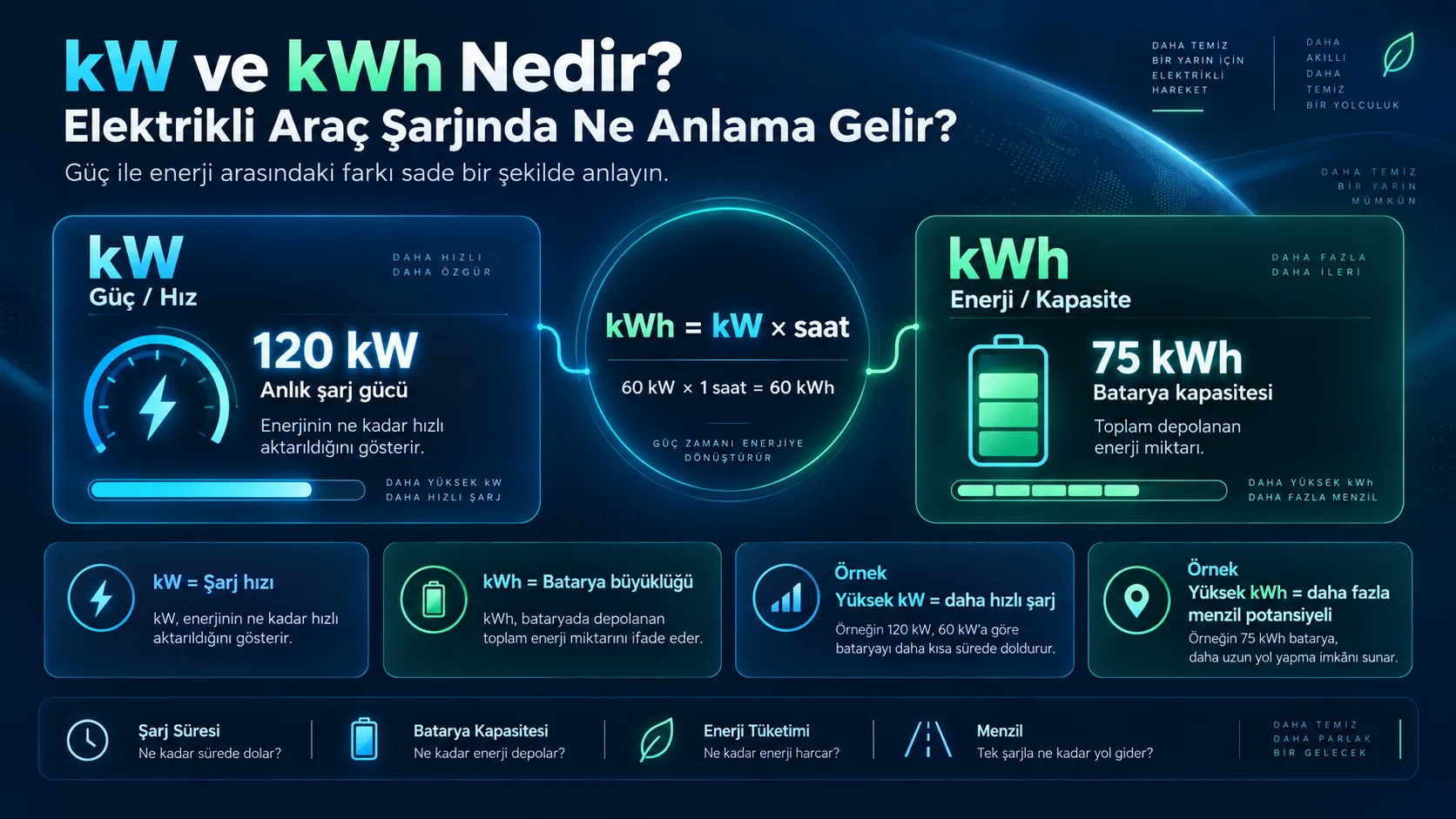
Table of contents
What Do kW and kWh Mean in EV Charging?
Two units appear repeatedly in EV specifications: kW and kWh. A vehicle might have a 75 kWh battery, support 150 kW DC charging and accept 11 kW AC charging. The units look similar, but they describe different things:
kW = power — the rate at which energy is transferred.
kWh = energy — the amount stored or delivered.
Knowing the distinction helps you interpret battery size, charging speed, time, range and cost.
What is kW?
A kilowatt (kW) is a unit of power. In EV charging, it expresses how quickly a station can transfer energy at a given moment. Ratings such as 11 kW AC, 60 kW DC or 180 kW DC describe power levels.
A higher kW rating can allow faster charging under suitable conditions. But a station’s maximum rating does not mean every connected car will always charge at that power. Vehicle capabilities and current charging conditions also set limits.
What is kWh?
A kilowatt-hour (kWh) is a unit of energy. It is commonly used to describe battery capacity. A 75 kWh battery can theoretically store about 75 kilowatt-hours of energy. That number does not directly state how fast the vehicle charges.
What is the difference between kW and kWh?
Imagine a water tank. kWh is like the size of the tank; kW is like the rate of flow through the pipe that fills it. A large tank does not automatically fill quickly, and a faster pipe does not make the tank larger.
For EVs:
- Battery capacity is expressed in kWh.
- Charging power is expressed in kW.
A simple charging example
Suppose a 60 kWh battery needs 60 kWh of energy. At a constant 60 kW, the theoretical time would be:
60 kWh ÷ 60 kW = 1 hour
At an average of 120 kW, it would be:
60 kWh ÷ 120 kW = 0.5 hour, or about 30 minutes.
Real sessions take longer or vary because power is not constant and energy is lost during charging. The calculation is useful for understanding the units, not for promising an exact charging time.
Why is battery capacity measured in kWh?
A battery stores energy. A 100 kWh battery can store more energy than a 50 kWh battery, all else equal, and will generally support a longer driving range.
Range also depends on vehicle weight, aerodynamics, motor efficiency, speed, temperature, climate control, terrain and driving style. Two vehicles with 80 kWh batteries can therefore have different ranges.
Why is station capacity measured in kW?
A station transfers energy over time, so its output is stated as power. A 120 kW DC station may be able to deliver up to 120 kW under suitable conditions, provided the vehicle can accept it.
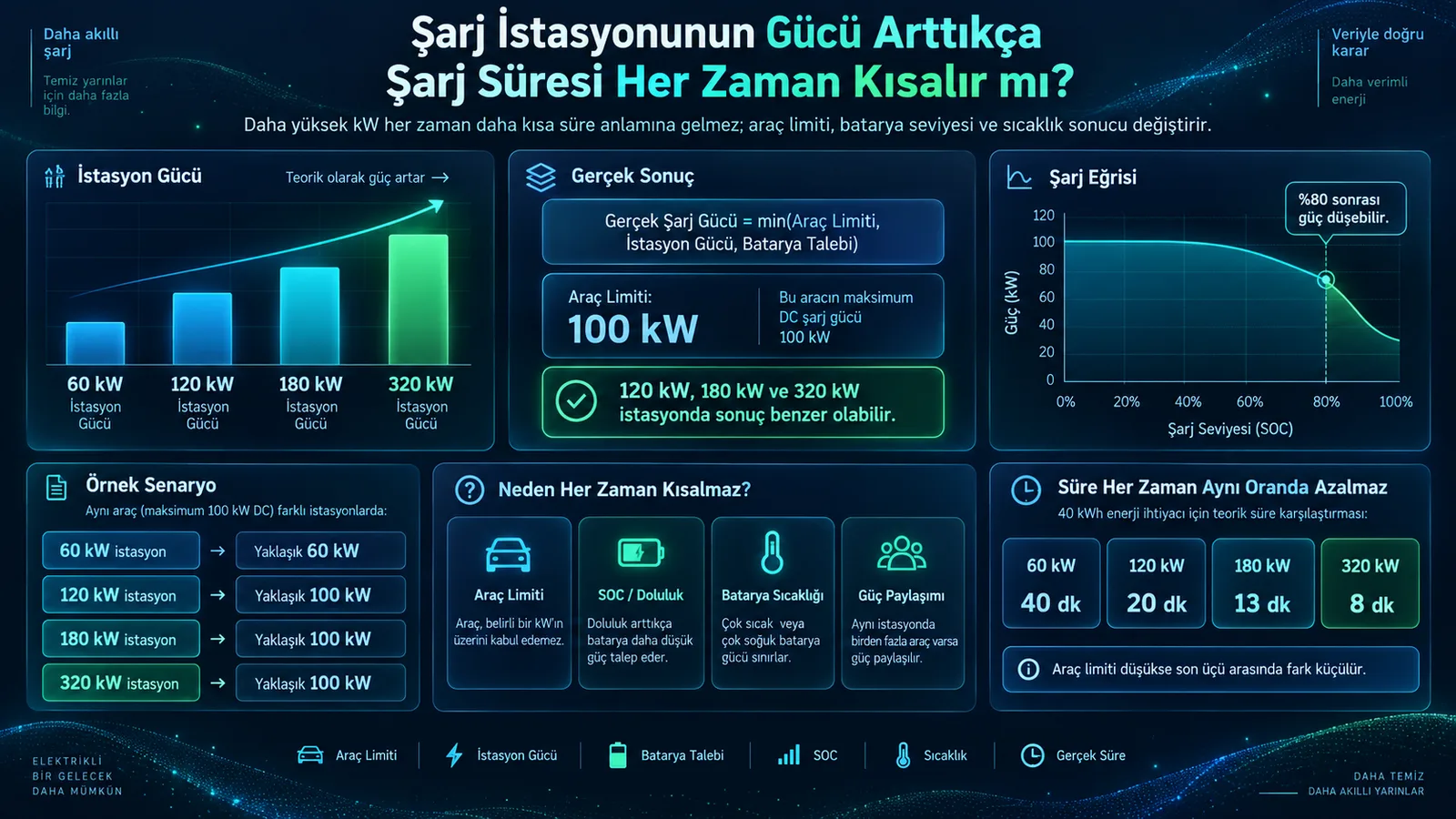
Why might a car draw only 80 kW from a 180 kW station?
Suppose the station supports 180 kW, the car’s maximum is 100 kW, and the car requests 80 kW at that moment. Actual charging power can be around 80 kW. The station does not force 180 kW into the vehicle; the two systems communicate to control energy transfer.
Peak power is not average power
A vehicle advertised with 150 kW maximum DC charging may reach that peak only under certain conditions. Its session might, for illustration, progress through 150 kW at 10–30% battery, 120 kW at 30–60%, 80 kW at 60–80% and 40 kW above 80%.
The average power across the session would be lower than the 150 kW peak. Charging-time estimates should account for the charging curve, not just the largest number in a specification.
What does a 22 kW AC station mean?
It can supply up to 22 kW AC in suitable conditions. A car may accept only 7.4, 11 or 22 kW AC. If its onboard charger is limited to 11 kW, connecting it to a 22 kW station will generally result in around 11 kW:
22 kW station + 11 kW vehicle limit → about 11 kW charging
The same principle applies to DC charging. A 200 kW-capable car connected to a 120 kW station is limited by the station; a 90 kW-capable car connected to a 180 kW station is limited by the car.
kWh also measures energy delivered in a session
The unit does not apply only to battery size. A receipt might show that a session delivered 32.5 kWh. That states the amount of energy, not the session length.
For example, charging at an average of 60 kW for half an hour gives approximately:
60 kW × 0.5 hour = 30 kWh
How far can a car travel on 1 kWh?
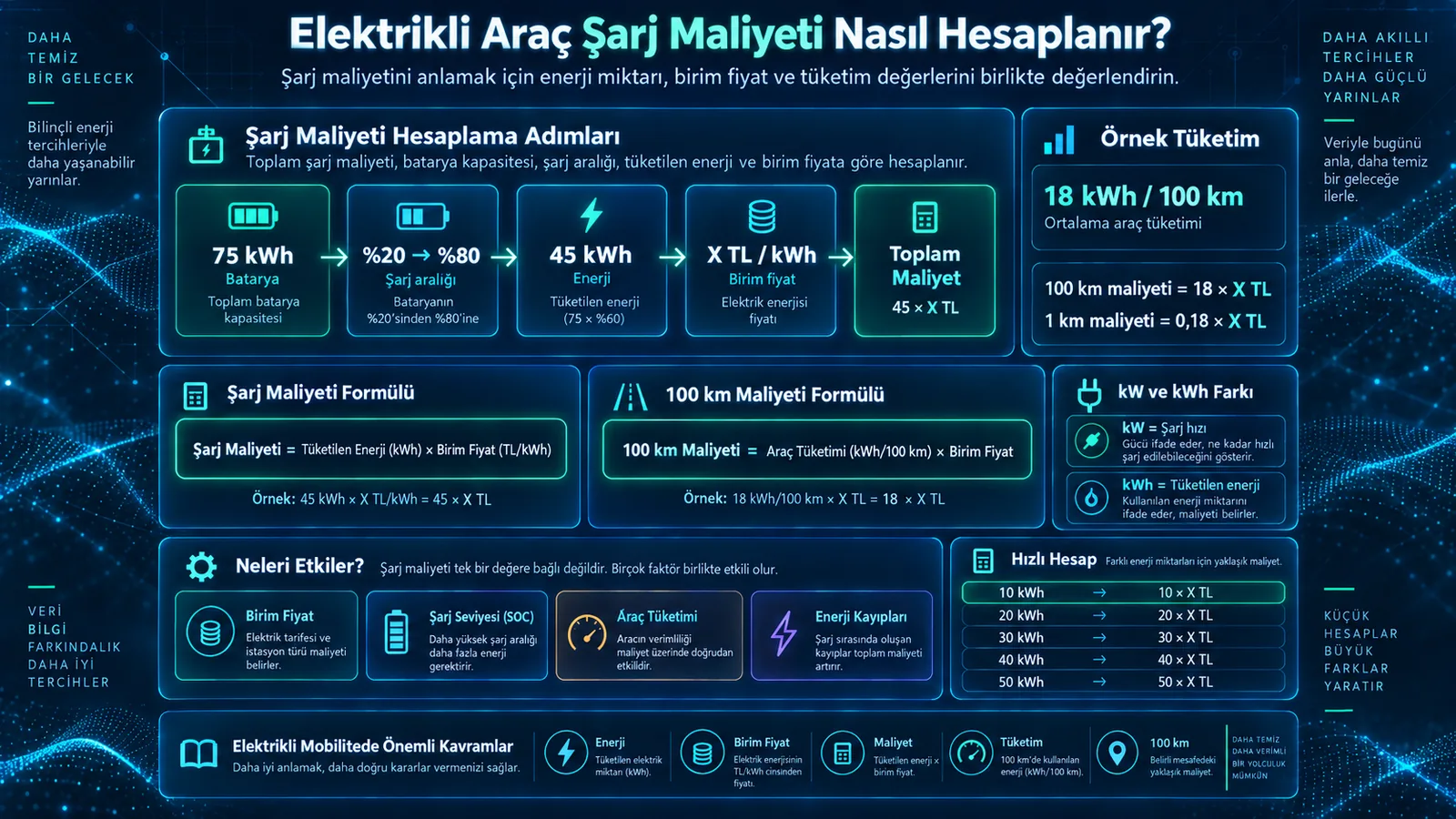
That depends on consumption, commonly expressed as kWh/100 km. A car averaging 18 kWh/100 km could theoretically travel:
100 ÷ 18 ≈ 5.6 km per kWh
Actual consumption changes with driving conditions.
Estimating range from battery capacity
With 72 kWh of usable battery capacity and average consumption of 18 kWh/100 km, a simplified calculation gives:
72 ÷ 18 × 100 = 400 km
Weather, speed and other conditions can make real-world range different.
Is charging cost based on kW or kWh?
For an energy-based tariff, cost is calculated from kWh delivered. If a session delivers 40 kWh at a price of X per kWh, the energy charge is approximately 40 × X. Other tariff components may apply, so check the operator’s pricing.
How are power, energy and time related?
The basic relationship is:
Energy = Power × Time
In these units: kWh = kW × hours. At a constant 50 kW for two hours, 100 kWh would be transferred. Rearranging the formula gives Time = Energy ÷ Power for a simplified estimate.
A common unit mistake
“My car has a 75 kW battery” uses the wrong unit for capacity. Say 75 kWh battery. Similarly, say 120 kW charger, not “120 kWh charger.”
| Measurement | Unit | Example |
|---|---|---|
| Charging power | kW | 120 kW DC charger |
| Battery capacity | kWh | 75 kWh battery |
| Session energy | kWh | 32.5 kWh delivered |
| Vehicle consumption | kWh/100 km | 18 kWh/100 km |
| Unit energy price | Price/kWh | Charging tariff |
Which values matter when selecting a station?
Consider the vehicle’s maximum AC and DC charging power, the station’s kW rating, the battery’s kWh capacity and the time available. A car may have a large 100 kWh battery but accept only 50 kW DC, which will shape its charging time.
Conclusion
kW describes how fast energy can move; kWh describes how much energy is stored or delivered. Understanding both makes charging time, battery capacity, consumption and cost easier to assess. Ask two different questions: “How big is the battery?” (kWh) and “How fast can it charge?” (kW).
About the author
Charge Teknoloji
Charging Infrastructure Team
Charge Teknoloji develops locally manufactured DC charging stations and OCPP-compatible charging network software.
LinkedIn arrow_outwardBe the first to hear about updates
Follow new content on electric vehicles and charging technologies.