What Is Fleet Charging and How Should Businesses Plan It?
Plan fleet charging around daily kWh, vehicle parking time, AC and DC needs, power sharing, operating schedules and growth.
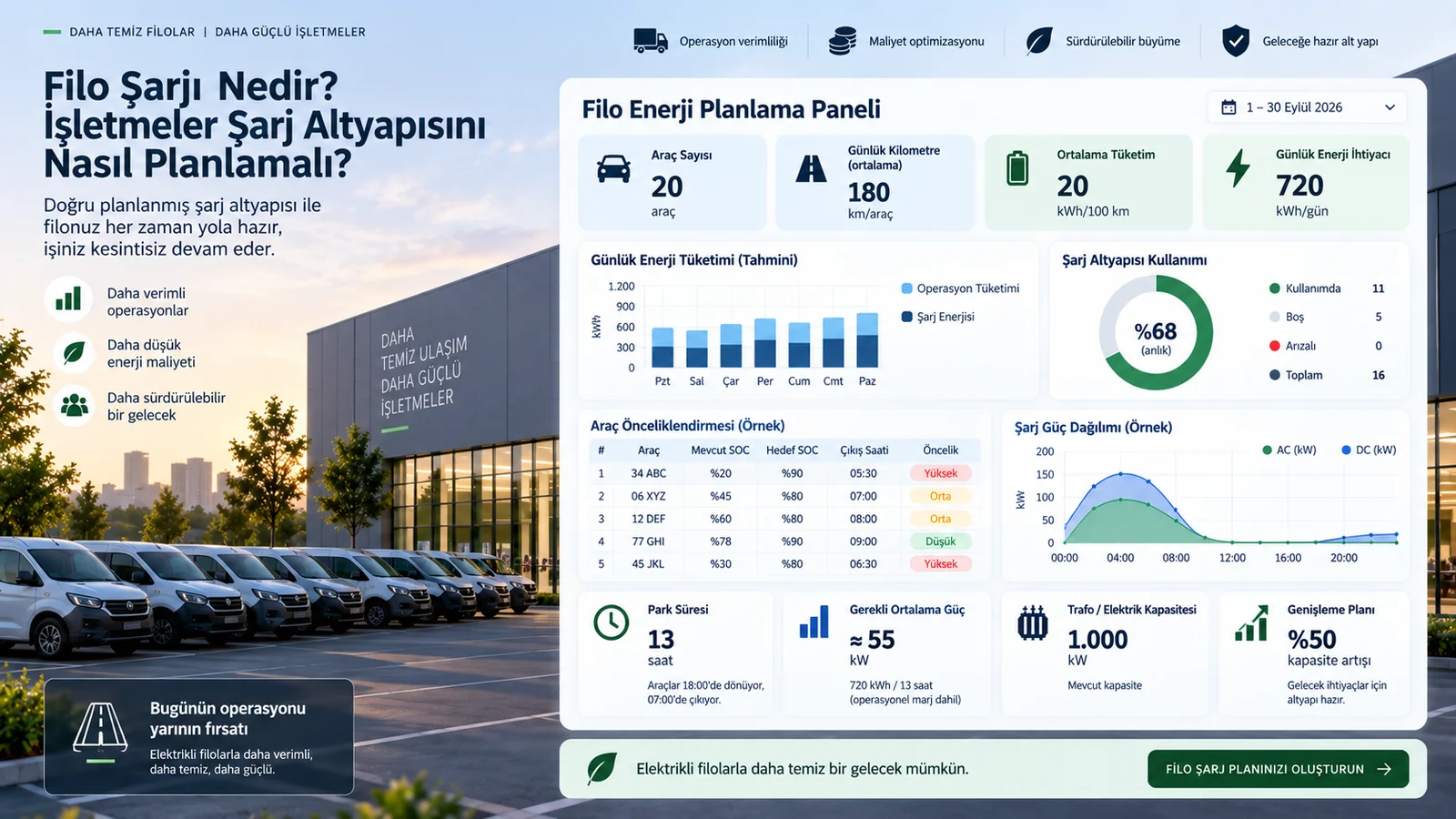
Table of contents
What Is Fleet Charging and How Should Businesses Plan It?
Fleet charging supplies energy to vehicles that serve a business on a defined schedule. Unlike an individual driver, a fleet manager must make sure every vehicle needed for the next shift is ready at departure. The starting figures are daily energy demand, the time vehicles remain parked and the site’s available electrical power.
Calculate energy before selecting charger power
Suppose one vehicle travels 180 km per day and consumes 20 kWh/100 km. It needs approximately 180 × 20 ÷ 100 = 36 kWh to replace that day’s driving. Twenty such vehicles need 20 × 36 = 720 kWh. Their combined battery capacity could be much larger, but batteries are not emptied and refilled completely every day.
If all twenty vehicles park for 13 hours, the ideal average power to deliver 720 kWh is 720 ÷ 13 ≈ 55 kW. Allowance is needed for losses, scheduling and uneven arrivals, but this is far below the 20 × 22 = 440 kW nameplate total of twenty 22 kW chargers. Maximum connector ratings are not the same as continuous fleet demand.
Parking time changes the answer. If one vehicle needs 35 kWh and remains for ten hours, its ideal average requirement is only 3.5 kW. If the fleet has only two hours to receive 600 kWh, the ideal average rises to 300 kW. Short turnaround may justify DC; long overnight parking often favours managed AC.
Choose AC, DC or a combination
AC depot charging can serve vehicles parked overnight. DC charging can support vehicles with short gaps between duties, high daily mileage or urgent returns to service. A mixed fleet might charge 24 vehicles overnight on AC and use DC for six vehicles during operational breaks. Public charging can supplement a fleet, but depending on it for critical daily departures introduces availability and routing considerations.
Connector count and available power are separate decisions. A site may need enough bays for vehicles to plug in when they return, even if those bays share a lower power ceiling. For example, twenty vehicles on a site with 100 kW available for charging would average 5 kW each if all drew power evenly. A managed system could instead give an urgent vehicle 11 kW, others 3–4 kW and a sufficiently charged vehicle no power temporarily.
Make the charging schedule operational
Record each vehicle’s route, expected return, next departure, daily kilometres, energy consumption and minimum required SOC. Give earlier departures or lower batteries appropriate priority. There is no need to charge every vehicle to 100% if its next assignment requires less, subject to vehicle and operational guidance.
Weather, HVAC use, payload and driving conditions can change actual kWh/100 km. A commercial vehicle using 24 kWh/100 km over 200 km needs approximately 48 kWh that day; a 50-vehicle fleet at the same average would need 2,400 kWh per day. Use measured data to improve estimates rather than treating a catalogue figure as a guarantee.
Vehicle identification and session records allow energy to be assigned to each vehicle. Tracking kWh/100 km, charger use, faults and missed departure targets helps identify operational issues. Central control can also shift charging to suitable tariff periods while meeting departure deadlines.
Fit charging within the facility
The facility’s existing consumption and grid capacity set the charging limit. If a 400 kW connection already supports 300 kW of other loads at a given time, only about 100 kW remains before design margins. Dynamic load management can adjust charger demand as building load changes. Solar generation and storage may be evaluated, but they do not remove the need for a capacity study.
Consider redundancy and maintenance. If forty vehicles must leave a depot each morning, a single unavailable charger can become an operational problem. Spare connectors, service response and monitoring should reflect the cost of a missed departure.
Finally, plan growth. A fleet with ten electric vehicles today may have fifty later. Space, cable routes and switchgear can be prepared in phases while charger numbers expand with measured demand. The objective is the required kWh in each vehicle before it leaves, delivered reliably within the site’s power and operating constraints.
About the author
Charge Teknoloji
Charging Infrastructure Team
Charge Teknoloji develops locally manufactured DC charging stations and OCPP-compatible charging network software.
LinkedIn arrow_outwardBe the first to hear about updates
Follow new content on electric vehicles and charging technologies.