DC Fast Charging Guide for Fuel Stations
Plan DC fast charging at a fuel station around stop duration, connector count, shared power, electrical capacity, traffic flow and operations.
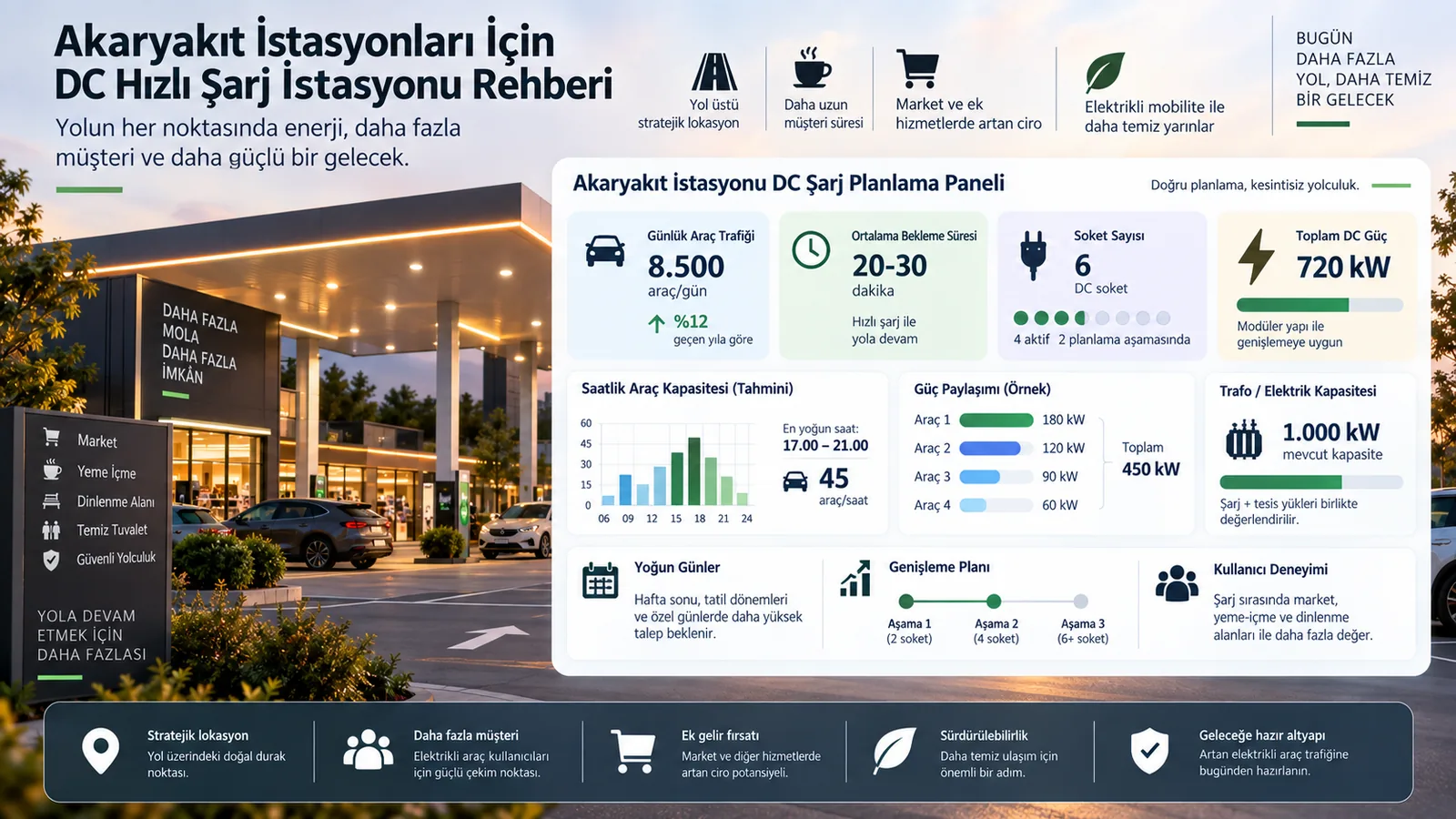
Table of contents
DC Fast Charging Guide for Fuel Stations
Fuel stations already offer road access, stopping space and services for travellers. Their charging use case is different from a hotel: many drivers want meaningful energy in a 15–30 minute break. DC fast charging is therefore often more appropriate than relying only on AC.
Start with the length of a stop
At a constant 11 kW, a 20-minute AC session would transfer only 11 × 1/3 ≈ 3.7 kWh in theory. At a constant 120 kW, the same time would represent 120 × 1/3 ≈ 40 kWh. These are ideal calculations. A car’s DC limit, battery temperature, state of charge and charging curve affect real energy delivered.
Likewise, adding 40 kWh at an average of 100 kW would take 40 ÷ 100 = 0.4 hours, or 24 minutes. Average power over the session matters more than the station’s brief peak. Drivers often leave before reaching 100% because charging usually slows at a high state of charge.
Which power and how many connectors?
There is no single rating for every station. A city location with moderate traffic may consider 60–120 kW, while a busy motorway site may justify 180–320 kW or more. But a 320 kW unit cannot force a car limited to 100 kW to accept 320 kW.
Connector count determines how many vehicles can be served simultaneously. With 360 kW of total planned capacity, one 360 kW connector, two 180 kW connectors and three 120 kW connectors offer different queueing and customer experiences. The right configuration depends on arrivals, average charging time and expected vehicle capabilities.
Dynamic power sharing can allocate a common DC power pool according to demand. On a 240 kW system, cars requesting 150 and 60 kW can theoretically receive a combined 210 kW if the equipment supports that split. When one car’s demand drops, spare capacity may be offered to another.
Verify the electrical connection
Four 180 kW points have 720 kW of combined nameplate output. A station’s existing grid connection may not support all points at full power alongside its other loads. First measure available capacity and peak demand; then assess network upgrades, managed charging or storage where appropriate. For example, if a site’s 500 kW connection is using 150 kW for other loads, about 350 kW remains before other design margins and constraints are considered.
Storage and solar generation may support an energy strategy, but they need a site-specific economic and technical assessment. Purchasing a 320 kW charger does not by itself create a 320 kW grid connection.
Make the site easy and safe to use
Position charging bays so cars can enter, park, reach the connector and leave without interfering with fuel pumps or traffic. Consider cable reach for different vehicle inlet positions, clear wayfinding, lighting, pedestrian routes and accessible use. Show whether a connector is occupied or out of service when possible.
Drivers may spend 20–30 minutes on site, so a comfortable waiting area, toilets and shop can improve the stop and may support other sales. Define how queues and cars occupying bays after charging are handled. Keep pricing clear, including any parking or overstay terms.
Plan operations across locations
Remote monitoring and an appropriate central system can report faults, status and energy use across multiple stations. OCPP can support integration, provided the chosen charger and platform work together in practice. Set expectations for maintenance and on-site support; a charger with an impressive rating is of little value when it is unavailable.
Before investing, collect traffic and peak-hour data, average stop duration, nearby competing charging options, EV demand, electricity capacity and projected expansion. Choose power and connector count together, then design the bays and operating model around the driver.
About the author
Charge Teknoloji
Charging Infrastructure Team
Charge Teknoloji develops locally manufactured DC charging stations and OCPP-compatible charging network software.
LinkedIn arrow_outwardBe the first to hear about updates
Follow new content on electric vehicles and charging technologies.